Posts Tagged ‘about yoga’

Staying Focused Without Getting Distracted: What Mindfulness and Yoga Can Offer

by on Tuesday, April 3rd, 2012

Anyone who works with a phone, a computer and a full inbox knows how easily the day gets pulled off course. Old articles about yoga for business people used this problem to argue that yoga helps you stay on target. There is something in that idea, but it is easy to oversell. Here is what mindfulness and yoga can realistically offer, what the research says and how to try a focus exercise yourself.

What does it mean to stay aware?

The National Center for Complementary and Integrative Health describes mindfulness as maintaining attention or awareness on the present moment without making judgments. Some forms of meditation ask you to hold your focus on one thing, such as your breathing, a sound or a repeated word. Yoga as it is practiced in the United States typically combines physical postures, breathing techniques and meditation, so a class is a way to practice paying attention. The idea in older writing, that you notice your thoughts and do not let them carry you away, is close to how mindfulness is taught today.

Does mindfulness really improve concentration?

Be careful here. Most of the research asks about stress, anxiety, depression, pain and sleep, not about productivity. NCCIH reports that a 2018 analysis of 142 groups of people with anxiety or depression found mindfulness-based approaches better than no treatment, and that mindfulness practices may help reduce insomnia and improve sleep quality. It also says that research on meditation has been hard to analyze and may have been interpreted too optimistically, and that much of the work on sleep and weight control has been preliminary. In other words, you may feel calmer, and a calmer mind may find it easier to stay on a task, but no study shows that yoga will make you more productive. If an article claims otherwise, ask where the evidence is.

Is a calm team a better team?

Probably, though it works both ways. The World Health Organization says safe and healthy working environments are more likely to improve staff retention, performance and productivity, and that excessive workloads and low control over your job are risks to mental health. So a company that wants a focused, calm staff needs more than a yoga room. It needs reasonable demands. As an individual, you can still do your part by looking after sleep and movement. For a gentler take on this, read our post on mind and spirit practices.

How can you practice focus in one minute?

This simple exercise is a common mindfulness technique and not a program from a study. Sit comfortably, close your eyes or look at one spot, and place your attention on the breath at the tip of your nose or in your belly. Count each out-breath up to ten, then begin again. When your mind wanders, which it will, notice it and return to the count without scolding yourself. That return is the exercise. To cut distractions between sessions, try three habits that many people find useful: put your phone out of reach for a block of work, do one task at a time, and plan short breaks so that you do not need to make your own.

Are there downsides?

For most people, mindfulness is low risk. NCCIH says these practices usually have few risks, but a 2020 review of 83 studies found that about 8 percent of participants had a negative effect, mostly anxiety and depression, which is similar to the rate for psychological therapies. If meditation makes you feel worse, stop and talk to a health professional. Take the same care with the physical side of yoga: choose a qualified instructor, start gently and see our posts on what yoga is and the gentle morning routine for a starting point.
Making Yoga a Lifetime Habit: How to Keep Going When Life Is Busy

by on Sunday, May 8th, 2011

Starting an exercise habit is easy. Keeping it going for years is the hard part. Older articles on yoga for business people claimed that executives who practice mind-body exercises stay with them longer than those who go to the gym. I could not find published results of such a study, so I will not repeat the claim as fact. What we can say is more practical: there are good reasons to make yoga part of your routine, and simple ways to stay with it.

How much activity do you need?

The Physical Activity Guidelines for Americans say that adults should do at least 150 to 300 minutes a week of moderate-intensity aerobic activity, such as brisk walking, plus muscle-strengthening activity on two or more days a week. The first edition counted only bouts of at least 10 minutes, but the second edition removed that requirement to encourage people to move more often throughout the day. That is good news for a busy schedule: a five-minute stretch counts as part of a more active day. Yoga alone does not meet the aerobic target, so most people will want to add walking or another activity. The National Institute on Aging lists yoga as one example of balance exercise, which also matters for staying independent as you age.

Does yoga help people take up other healthy habits?

There is some evidence. NCCIH reports a 2021 study of 60 women with obesity who were assigned to 12 yoga sessions or a waiting list. The effect of yoga on their body mass index depended on changes in physical activity and in daily fruit and vegetable intake, so the benefit seemed to come partly through other habits. A 2018 survey of 1,820 young adults found that regular yoga was associated with better eating and activity habits, and the people who answered said yoga made them more mindful and encouraged them to be more active. These studies show an association, not proof that yoga causes healthier living, but they fit the common experience that one good habit can pull others along.

How can you build the habit?

These ideas are general advice for forming habits, not findings from a yoga study. Start small: ten minutes a few times a week is better than an hour you never find time for. Attach it to something you already do, such as stretching after you brush your teeth or doing a few poses before your first coffee. Put it in your calendar like a meeting. Keep a mat or a chair in view. Try a class if you like company, since having someone expecting you makes it harder to skip. Vary it, too: a gentle morning routine such as the one in our beginner’s guide on some days, and a longer session on a weekend.

What if you miss a week?

Just begin again. The point of the guidelines is that the total across a week and a year matters more than any single session, so do not wait for the perfect Monday. If you stopped because of an injury or illness, return gradually and talk to a doctor if you are unsure. Remember the basics of safe practice from NCCIH: learn from a qualified instructor, avoid extreme poses while you are new, and tell your teacher about any health condition.

Where do you go from here?

If you are new, read about what yoga is and try the basic yoga postures. When you want to build your fitness more widely, see lifetime fitness for a plan that lasts. A habit that you enjoy is one you keep, so choose what suits you and let it grow.

Four Yoga Postures for Computer Users: Diamond, Locust, Downward Dog and a Seated Twist

by on Tuesday, March 15th, 2011

Sitting still for hours stiffens the back, hips and shoulders, and a few minutes of movement can make a difference. This guide covers four classic yoga postures that suit people who work at a screen: the diamond posture, the locust, the downward-facing dog and a seated twist. Each is described step by step, with notes on who should take care. Move slowly, breathe normally, and stop if anything hurts.

What should you know before you start?

Follow the basic stretching rules from Harvard Health Publishing: warm up for five to ten minutes with light activity, do not bounce, expect tension but not pain, and hold each posture for roughly 30 seconds, which is about five slow breaths. The National Center for Complementary and Integrative Health says that yoga is generally safe when done properly under a qualified instructor, and that sprains and strains are the most common injuries, most often in the knee or lower leg. It also suggests beginners avoid extreme practices such as headstands and forceful breathing. If you have a medical condition, check first with your doctor.

How do you do the diamond posture (Vajrasana)?

Kneel on a carpet or folded blanket with your knees together and sit back on your heels. Lift your chest so your ear, shoulder, elbow and hip are in one line, and rest your hands on your thighs. Stay for a few minutes and breathe. Many people find this a calm way to sit, but it asks a lot of the knees and ankles. If kneeling hurts, put a folded blanket between your calves and thighs or skip it, and do not do it if you have a knee injury.

How do you do the locust (Salabhasana)?

Lie face down with your chin or forehead on the floor and your arms by your sides, palms down. Exhale and lift your legs a few inches, squeezing your buttocks and stretching the legs back. Hold for a few breaths, lower with control and repeat two or three times. This posture strengthens the muscles of the back and legs, but it is not for everyone. MedlinePlus lists leg lifts while lying on the stomach among the exercises to avoid while you recover from a back injury unless your provider or physical therapist says it is all right, so skip it if you have back pain.

How do you do the downward-facing dog (Adho mukha svanasana)?

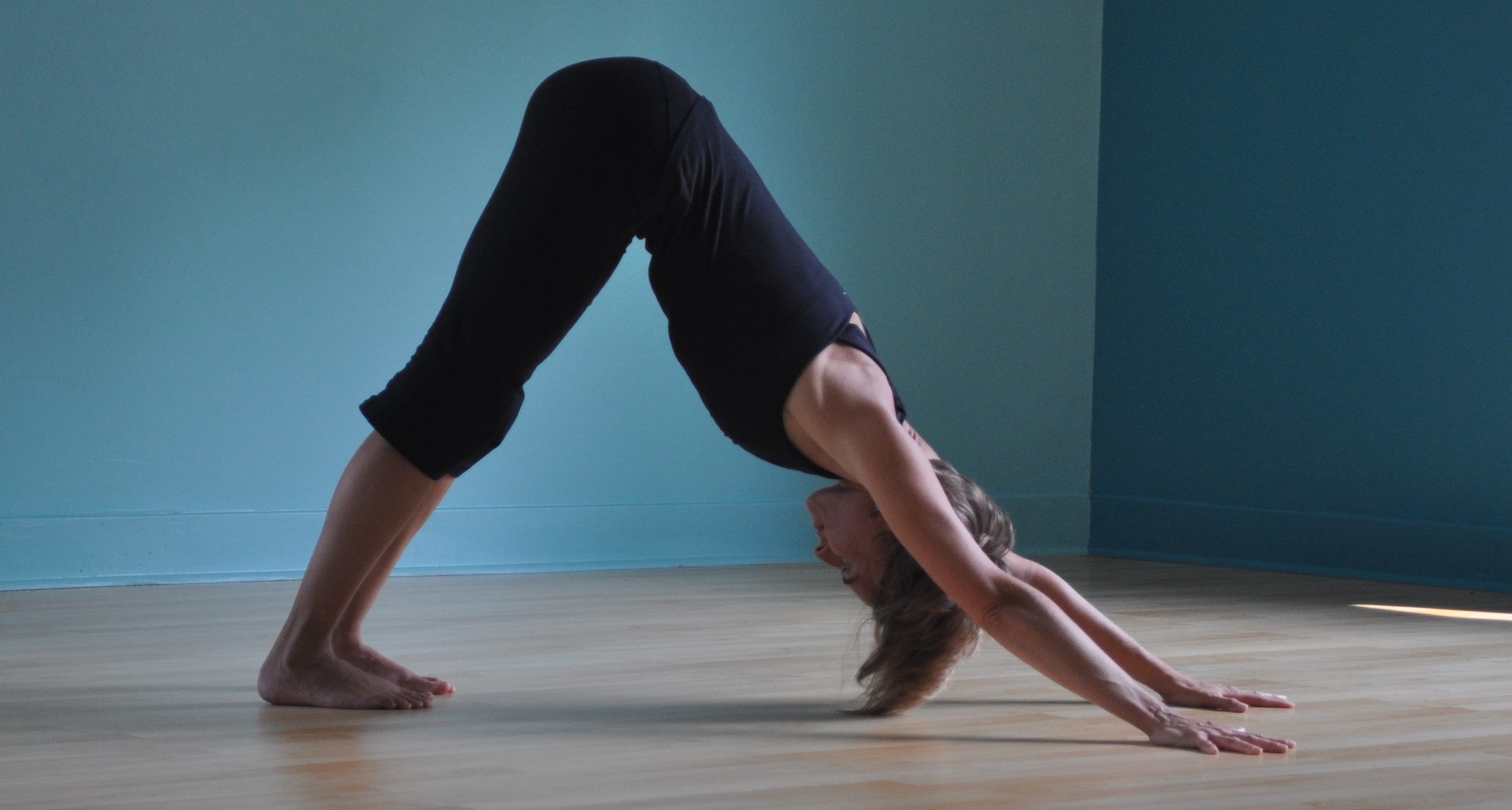
Start on hands and knees with your hands under your shoulders. Tuck your toes, press into your hands and lift your hips up and back so that your body forms an upside-down V. Keep your knees slightly bent if your hamstrings are tight, push the floor away and let your head hang between your arms. Hold for about five breaths, then lower your knees slowly. This stretches the backs of the legs and the shoulders. If you have wrist pain, high blood pressure or an eye condition such as glaucoma, ask your doctor first, because NCCIH lists severe high blood pressure and glaucoma among the conditions that may call for changes to poses.

How do you do a seated twist?

The traditional twist, Bharadvajasana, starts from a kneeling position. A simpler version works in a chair. Sit tall on the front half of the chair with your feet flat on the floor. Place your right hand on the outside of your left knee, hold the back of the chair with your left hand and turn gently to the left, looking over your left shoulder. Keep your hips facing forward and your spine long. Hold for three to five breaths and repeat on the other side. The old version of this article said to do the twist once an hour if you have lower back pain. I have removed that advice, because there is no basis for it. A better habit is to get up and move often, in line with the Physical Activity Guidelines for Americans, which tell adults to sit less.

Where can you learn more?

Our post on basic yoga postures explains more poses, and yoga postures and styles gives an overview of the main styles. For a standing stretch that suits a desk break, try the triangle pose, and read what yoga is if you are just starting out. The photo below shows the downward-facing dog.

Yoga pose for computer users stretching back and hamstrings.

Adho mukha svanasana Yoga for Computer Users

Book: Yoga for Computer Users by Sandy Blaine
View this book on Amazon (affiliate link: we may earn a commission at no cost to you)