Archive for May, 2011

Tales from the Yoga Studio Rain Mitchell

by on Tuesday, May 31st, 2011

A sparkling new series introducing five unforgettable women who flock to yoga at turning points in their lives and find the gift of lasting friendship.

The yoga studio is where daily cares are set aside, mats are unfurled, and physical exertion leads to well-being, renewal, and friendship. An aggressively expanding chain of Los Angeles yoga “experience centers,” has Lee and her extraordinary teaching abilities in its sights. They woo her with a lucrative contract, a trademarked name for her classes, and a place for her handsome musician husband. But accepting the contract means abandoning the students at the homey studio Lee runs in L.A.’s Silver Lake district- and leaving behind four women whose friendships are suddenly more important to her than retirement benefits and a salary increase.

What is this book about?

The description presents it as a new series about five women who come to yoga at turning points in their lives and find lasting friendship.

Who wrote Tales from the Yoga Studio?

The book is credited to Rain Mitchell in the title. The description reads like fiction, so this is a story rather than an instruction book.

What happens in the story?

The part of the story the description gives is about Lee, who runs a homey yoga studio in Los Angeles’ Silver Lake district. A growing chain of yoga “experience centers” offers her a lucrative contract and a trademarked name for her classes. Accepting would mean leaving her students and four women whose friendships have become more important to her than a higher salary.

This summary is based on the book description on the Amazon page.

What happens in a first yoga class?

Fiction about a yoga studio can make a class sound simple, so here is what a beginner typically meets. Most classes start with settling the breath, move through standing and floor postures, and end with a short rest. The Harvard Health yoga article describes hatha-style sessions in just that order: breathing exercises, a series of postures, then a rest at the end.

Wear clothes you can move in, arrive a few minutes early, and tell the teacher about any injury or pregnancy. Skipping a pose is always allowed. The NIH National Center for Complementary and Integrative Health (NCCIH) page on yoga suggests asking about the teacher’s training and avoiding extreme practices while you are new. If you have a health condition, ask your doctor before your first class.

More on this blog: A Short History of Yoga: From Ancient Texts to Hatha Classes and a Record Number of Americans and What Is Yoga?

Book: Tales from the Yoga Studio by Rain Mitchell
View this book on Amazon (affiliate link: we may earn a commission at no cost to you)
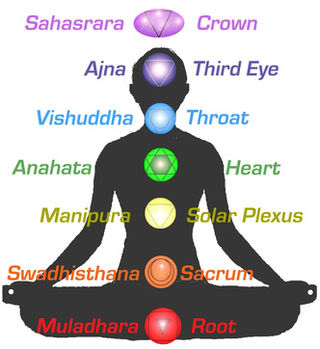
The Seven Chakras: Names, Locations and Meanings

by on Sunday, May 29th, 2011

The seven chakras

What are chakras?

The word chakra is Sanskrit for “wheel” or “disc”. In yoga, Hinduism and Tantric Buddhism, chakras are described as energy centers in the body, lined up along the spine from its base to the crown of the head. Encyclopaedia Britannica describes them as focal points where psychic forces and bodily functions meet. They belong to a spiritual tradition and are not organs that you can see on a scan. Some texts speak of thousands of chakras, but seven main ones get most of the attention in modern yoga.

Each chakra is linked to an area of the body, a set of emotional and behavioral themes, a color and many other qualities, such as identity, goals and rights. Colors and meanings differ a little between traditions, and the rainbow scheme is the one most common today.

The lower chakras: root, sacral and solar plexus

Muladhara, the root chakra, is at the base of the spine. It is linked to stability, security and survival, and its color is usually red.

Svadhisthana, the sacral chakra, is in the lower abdomen, the pelvic area and the lower back and hips. It is linked to emotions, creativity and pleasure, and is usually shown in orange.

Manipura, the solar plexus chakra, is in the upper abdomen. It is linked to confidence, willpower and personal power, and is usually yellow.

The upper chakras: heart, throat, brow and crown

Anahata, the heart chakra, is at the center of the chest. It is linked to love, compassion and connection with others, and is usually green.

Vishuddha, the throat chakra, is in the throat. It is linked to communication and self-expression, and is usually blue.

Ajna, the brow chakra, sits between the eyebrows and is often called the third eye. It is linked to intuition and insight, and is usually indigo.

Sahasrara, the crown chakra, is at the top of the head. It is linked to spiritual awareness and a sense of connection with something larger than yourself, and is usually violet or white.

What is kundalini?

In the tradition, a spiritual energy called kundalini lies dormant at the base of the spine, in the root chakra. It is often pictured as a coiled snake. Yogic practices aim to raise it step by step through the chakras until it reaches the crown, which is the stage of self-illumination. The chakras are described as valves or pumps that regulate the flow of this energy through your system.

How does yoga come into it?

Teachers of this tradition say that the movements, postures and breathing of yoga, together with meditation, can help you focus on each center in turn and bring a sense of balance to your mind, body and spirit. These are traditional beliefs, and there is no scientific proof that chakras exist as physical structures. You can read more about how people work with them, and what research says, in our companion post on chakras and yoga. If you are new to yoga, start with our post on what yoga is and learn about the history in the origins of yoga.

The seven chakras

The seven chakras

Guide to Yoga No OM Zone

by on Friday, May 27th, 2011

Kimberly Fowler is a well-known Los Angeles-based yoga teacher. She is the founder of the Yoga and Spinning (YAS) Fitness Centers in LA and has made several yoga workout DVDs, including Yoga for Athletes. Her mission, as the book’s subtitle makes plain, is to make yoga accessible to those who are uncomfortable with chanting, granola, and Sanskrit.

Famed yoga rebel-with-a-cause, Kimberly Fowler’s practical guide to the ancient art has hit the bookstands. The No OM Zone: No Chanting, No Granola, No Sanskrit and companion workout DVD furthers her mission to take the mystery and intimidation out of yoga for those still leery of the practice and to welcome newcomers, introducing them to a fun and fulfilling practice.

Who wrote it?

Kimberly Fowler is described as a well-known Los Angeles-based yoga teacher, the founder of the Yoga and Spinning (YAS) Fitness Centers in LA, who has made several workout DVDs including Yoga for Athletes.

Who is The No OM Zone meant for?

According to the description, it aims to make yoga accessible to people who are uncomfortable with chanting, granola and Sanskrit, and who are still leery of the practice.

Is it written for beginners?

The book description says the book is meant to “welcome newcomers” and take the mystery and intimidation out of yoga.

What does The No OM Zone cover?

The description presents the book as a practical guide by Kimberly Fowler whose subtitle is No Chanting, No Granola, No Sanskrit. It comes with a companion workout DVD.

Everything above comes from the book description on its Amazon page.

How does yoga fit with other kinds of exercise?

Yoga can sit alongside other training rather than replace it. The WHO activity fact sheet recommends adults aim for at least 150 minutes of moderate aerobic activity each week and muscle-strengthening work on two or more days. Yoga contributes flexibility, balance and body awareness, which are different from the heart-rate work of running or cycling.

People who already train hard often notice tight hips, shoulders or hamstrings, and slower, held postures are one way to give those areas attention. Treat it as a complement to your regular routine, not a shortcut, and keep rest days in your week.

The NCCIH page on yoga adds that injury risk in yoga is lower than in higher-impact activities, though sprains and strains still happen. Build up gradually and ask a doctor if you are returning from injury.

More on this blog: A Ten-Minute Yoga Routine for Low-Energy Days: Six Simple Moves and How to Choose a Yoga Video for Beginners (and What a Good One Teaches)

View this book on Amazon (affiliate link: we may earn a commission at no cost to you)

Cool Yoga Tricks by Miriam Austin

by on Wednesday, May 25th, 2011

An easy-to-follow guide that shows how those of us with normal flexibility limitations can experience the benefits of yoga, using everyday objects like walls, chairs and blankets. Alternative yoga routines that help you reap the greatest rewards fromyour yoga practice. As your body becomes more flexible, your mind and attitude will too.

MIRIAM AUSTIN has been a student of yoga since 1985 and has taught for many years. Instructing people with normal physical limitations as well as those with serious injuries and illness, through yoga, Miriam has helped people heal themselves of lupus, arthritis, asthma, and high blood pressure and has helped many find relief from back and neck pain. She is the bestselling author of Yoga for Wimps: Poses for the Flexibly Impaired and Meditation for Wimps: Finding your Balance in an Imperfect World.From the Trade Paperback edition.

Who is the author?

The author is Miriam Austin. The description says she has studied yoga since 1985, has taught for many years, and wrote Yoga for Wimps and Meditation for Wimps. The description also credits her with helping people heal themselves of several conditions. That is her description’s statement and is not confirmed here.

Who is this book written for?

The description speaks to people with normal flexibility limitations. It does not say whether any medical condition needs approval from a doctor first.

What is this book about?

The description calls it an easy-to-follow guide that shows how people with normal flexibility limitations can experience the benefits of yoga using everyday objects such as walls, chairs and blankets.

This summary of the book description is not medical advice.

Do I need to be flexible to start yoga?

No. Flexibility is something yoga tends to build over time rather than something you must bring on day one. The Harvard Health article on yoga describes the aim of a session as challenging yourself without being overwhelmed, with attention staying on the breath. If your breath turns ragged or forced, that is a signal to back off.

Props can help. A chair can support a seated twist, a wall can steady balance, and a folded blanket can lift the hips in a seated pose. The NIH yoga summary from NCCIH points out that styles range from gentle to demanding, so choose the gentle end when your range of motion is limited.

If you have a joint problem, osteoporosis or recent surgery, ask your doctor which movements to avoid.

Related on this blog: What Is Yoga? and Basic Yoga Postures and Their Variations: Cobra, Bow and Shooting Bow Step by Step

Book: Cool Yoga Tricks by Miriam Austin
View this book on Amazon (affiliate link: we may earn a commission at no cost to you)

Vitamins and Your Health: Do You Need a Supplement?

by on Monday, May 23rd, 2011

Vitamins and your health

Can you get all your vitamins from food?

Most of us know that vitamins are part of a healthy, disease-free way of life. Vitamin products have also become far more specialized than they used to be, and many are aimed at particular parts of your body or your health. That does not mean everyone needs them. For most healthy people who eat a varied diet with plenty of vegetables, fruit, whole grains, beans, nuts and dairy or fortified foods, food covers vitamin needs. Multivitamins cannot take the place of the variety of foods in a healthy diet, according to the US National Institutes of Health.

Supplements are meant to fill gaps, not to replace meals. The tricky part is knowing whether you have a gap.

Who may need a supplement?

Some people do find it hard to get what they need from food alone. This is more likely if you follow a vegetarian or vegan diet, have food allergies or other dietary restrictions, have a small appetite so that you feel full quickly, are an older adult, are pregnant, or have a medical condition that affects how your body absorbs nutrients. Vitamin B12 is the best example for readers of this blog. It is found naturally in animal foods such as fish, meat, eggs and dairy products, but not in plant foods, so vegans in particular need fortified foods, such as some breakfast cereals and nutritional yeast, or a supplement. Adults need 2.4 micrograms a day, according to the NIH Office of Dietary Supplements.

If you are not sure, ask your doctor. A simple blood test can show whether you are low in a vitamin, and our post on whether vegetarians need vitamin supplements covers more of the basics.

What do the main vitamins do?

B12 helps to keep your nerves and blood cells healthy. Many people think that it boosts energy, but the evidence shows that extra B12 only improves energy and performance if you were short of it to begin with. Vitamin A supports vision and the immune system. Vitamin C helps your body heal wounds and absorb iron, and you can read about it in our post on why you need vitamin C and where to find it. Vitamin D works with calcium to keep bones strong. Vitamin E is an antioxidant, and our post on vitamin E explains what it does and how much you need. Taking more than you need does not give you extra health, and some vitamins can do harm in large doses.

What about selenium and colostrum?

Selenium is a mineral, not a vitamin. Adults need 55 micrograms a day, and most people in the United States get enough from food. People on vegetarian or vegan diets may have lower intakes, and Brazil nuts are particularly rich in it, so a few are enough. The upper limit is 400 micrograms a day, and chronic high intakes can cause hair and nail loss and other problems, which is why megadoses are a bad idea.

Colostrum, the first milk produced after birth, is sold as a supplement. It is not a vitamin, and studies in healthy adults have given limited and mixed results for immune support, so it is not something you need. The kind sold in supplements usually comes from cows, which matters if you are a vegan. Ask your doctor before adding it.

How do you decide?

Start with your diet, then talk to a doctor or pharmacist about anything you might be missing. If you do take a supplement, choose one that fits your age and needs, keep to the recommended amounts, and see our post on getting the right amount of vitamins. For tips on picking and using supplements, read our companion post on how to choose and use supplements wisely.