Archive for March, 2011

ฺThe Body Detox Diets For Dummies

by on Friday, March 18th, 2011

Detox Diets For Dummies is your guide to making informed choices about cleansing your body and mind safely and conveniently Researchers have found that we ingest dangerous chemicals every day in our food, water, and the air we breathe. Detox Diets For Dummies helps you understand the effects of these chemicals on your body and find safe, gentle methods to expel them from your system.
This comprehensive guide provides clear, reliable information on the leading detox plans so you can accurately assess your own needs and select the best plan for your desired detox goal. A screening quiz helps you identify the program and plan that best suits your lifestyle and personal detox objectives. Detox Diets For Dummies provides plenty of healthy recipes and exercises help clear your body of toxins without harmful or unpleasant side effects. * Helps you flush away harmful chemicals safely and easily * Reveals why some popular detox programs may cause more harm than good * Supplies a screening quiz to help you identify your personal detox needs and choose the right program * Recommends programs for quitting smoking or drinking, fighting allergies, and losing weight, calming stress and anxiety, increasing your energy, and revitalizing your spirit. * Includes more than 35 recipes for safe cleansing of toxins and other harmful agents Whether you are motivated by weight loss, disease prevention, metal purification, or physical revival-Read Detox Diets For Dummies for a variety of detox programs that are all natural and fit every lifestyle.

View this book on Amazon (affiliate link: we may earn a commission at no cost to you)
The Tao of Detox: Daniel Reid’s Natural Way to Purify the Body

by on Wednesday, March 16th, 2011

The Tao of Detox: Daniel Reid’s natural way to purify the body

Most people believe that they are completely safe in their homes, or in any other place they are used to. But it may be time to think twice. Why?

Our world is no longer the planet it was a very long time ago. When civilizations were just beginning to form, there was no industrial pollution. Because of the rapid changes that have taken place in almost every part of the world, our air, water and food now carry pollutants that earlier generations never met.

Who would not want to live a long life? Very few people reach 120 years or more, and despite popular legends, people did not routinely live that long in the past either. In fact, average life expectancy today is far higher than it was a century ago, thanks to better hygiene, nutrition and medicine.

Still, modern lifestyles take a toll on the whole body. With the hectic way of life many of us have grown used to, the body takes in more alcohol, additives and pollutants than is good for it. Normally the liver and kidneys clear these substances efficiently. Detox advocates such as Reid argue that when the body cannot keep up, these chemicals stay in the body and form build ups.

According to this view, such build-ups create imbalances in the body, and over time complications may arise. You may wonder how this could happen, but the answer, Reid says, lies in everyday habits.

Look at your daily life. Many of the foods you are used to eating contain additives, and drinks like soda, coffee and alcohol are not good for you in large amounts. Smokers take in harmful substances with every cigarette, and everyone breathes in exhaust from cars, trucks and other vehicles. Some hygiene products and the side effects of medicines add to the load. Note, though, that the idea of an “acid build-up” from these sources is not supported by medical science; your body keeps its acid balance within tight limits.

With so many harmful things around us, it is no surprise that many people get sick and look for a natural way to stay well. The wish for natural healing is shared by a great many people.

A body detox, in Reid’s view, is a way to rid your body of harmful chemicals that have been inside it for some time. A healthier lifestyle and better eating habits can certainly undo some of the damage caused by unhealthy habits, although no detox can reverse it all.

There are many detox resources you can turn to for guidance on the road to a healthier life. The book The Tao of Detox: The Natural Way to Purify Your Body for Health and Longevity, written by Daniel Reid, offers a holistic approach to cleansing the body. Reid argues that we need to clean our insides just as we need to clean our environment (and the whole planet).

The book offers a way to build up and look after your own health, which Reid believes is best achieved through detoxification.

If you want to lead a healthier life, this book may be a helpful guide to detox habits and to changing an unhealthy lifestyle. Talk to your doctor before starting any strict cleanse or fast.

Book: The Tao of Detox by Daniel Reid
View this book on Amazon (affiliate link: we may earn a commission at no cost to you)

Four Yoga Postures for Computer Users: Diamond, Locust, Downward Dog and a Seated Twist

by on Tuesday, March 15th, 2011

Sitting still for hours stiffens the back, hips and shoulders, and a few minutes of movement can make a difference. This guide covers four classic yoga postures that suit people who work at a screen: the diamond posture, the locust, the downward-facing dog and a seated twist. Each is described step by step, with notes on who should take care. Move slowly, breathe normally, and stop if anything hurts.

What should you know before you start?

Follow the basic stretching rules from Harvard Health Publishing: warm up for five to ten minutes with light activity, do not bounce, expect tension but not pain, and hold each posture for roughly 30 seconds, which is about five slow breaths. The National Center for Complementary and Integrative Health says that yoga is generally safe when done properly under a qualified instructor, and that sprains and strains are the most common injuries, most often in the knee or lower leg. It also suggests beginners avoid extreme practices such as headstands and forceful breathing. If you have a medical condition, check first with your doctor.

How do you do the diamond posture (Vajrasana)?

Kneel on a carpet or folded blanket with your knees together and sit back on your heels. Lift your chest so your ear, shoulder, elbow and hip are in one line, and rest your hands on your thighs. Stay for a few minutes and breathe. Many people find this a calm way to sit, but it asks a lot of the knees and ankles. If kneeling hurts, put a folded blanket between your calves and thighs or skip it, and do not do it if you have a knee injury.

How do you do the locust (Salabhasana)?

Lie face down with your chin or forehead on the floor and your arms by your sides, palms down. Exhale and lift your legs a few inches, squeezing your buttocks and stretching the legs back. Hold for a few breaths, lower with control and repeat two or three times. This posture strengthens the muscles of the back and legs, but it is not for everyone. MedlinePlus lists leg lifts while lying on the stomach among the exercises to avoid while you recover from a back injury unless your provider or physical therapist says it is all right, so skip it if you have back pain.

How do you do the downward-facing dog (Adho mukha svanasana)?

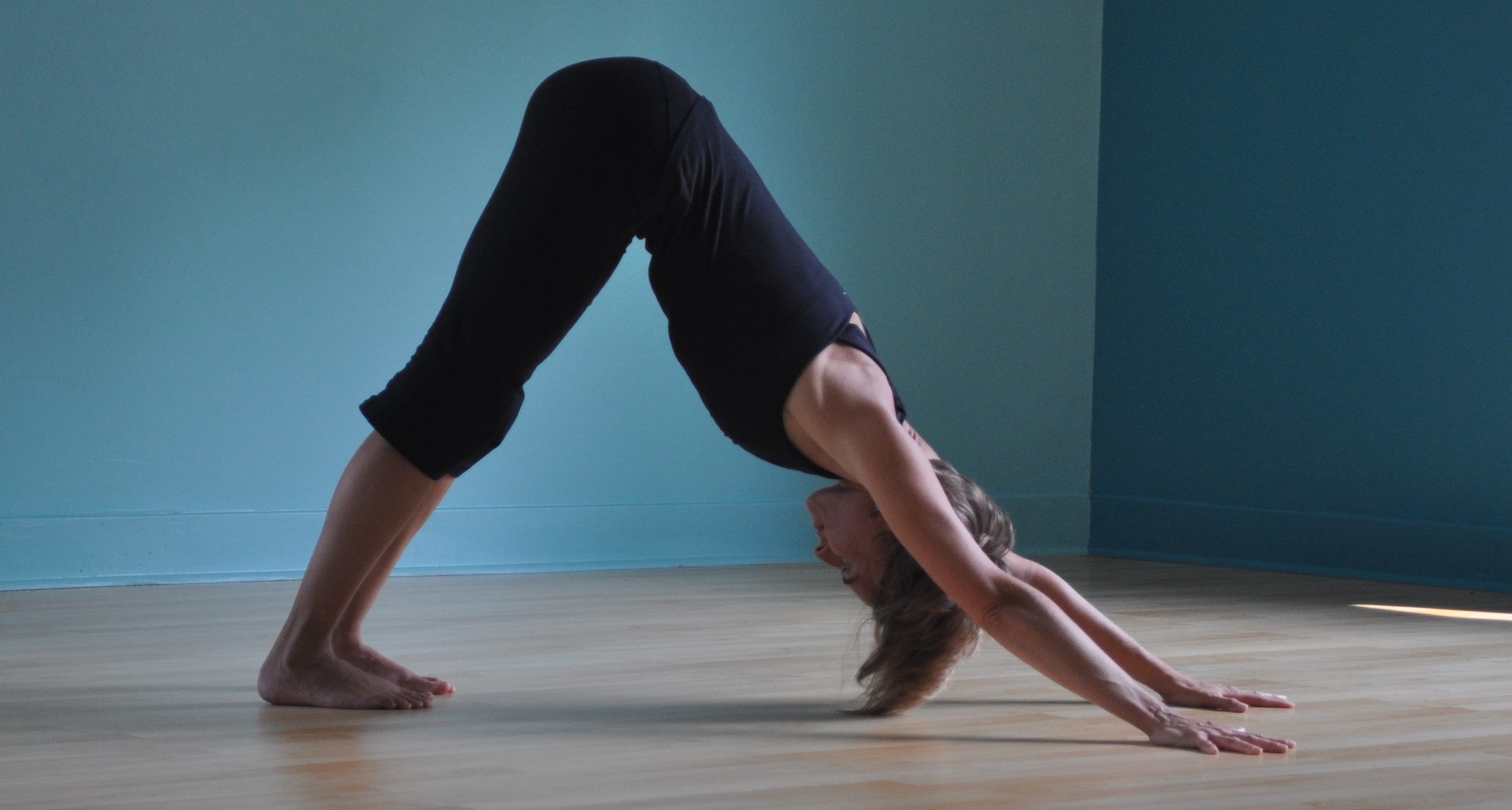
Start on hands and knees with your hands under your shoulders. Tuck your toes, press into your hands and lift your hips up and back so that your body forms an upside-down V. Keep your knees slightly bent if your hamstrings are tight, push the floor away and let your head hang between your arms. Hold for about five breaths, then lower your knees slowly. This stretches the backs of the legs and the shoulders. If you have wrist pain, high blood pressure or an eye condition such as glaucoma, ask your doctor first, because NCCIH lists severe high blood pressure and glaucoma among the conditions that may call for changes to poses.

How do you do a seated twist?

The traditional twist, Bharadvajasana, starts from a kneeling position. A simpler version works in a chair. Sit tall on the front half of the chair with your feet flat on the floor. Place your right hand on the outside of your left knee, hold the back of the chair with your left hand and turn gently to the left, looking over your left shoulder. Keep your hips facing forward and your spine long. Hold for three to five breaths and repeat on the other side. The old version of this article said to do the twist once an hour if you have lower back pain. I have removed that advice, because there is no basis for it. A better habit is to get up and move often, in line with the Physical Activity Guidelines for Americans, which tell adults to sit less.

Where can you learn more?

Our post on basic yoga postures explains more poses, and yoga postures and styles gives an overview of the main styles. For a standing stretch that suits a desk break, try the triangle pose, and read what yoga is if you are just starting out. The photo below shows the downward-facing dog.

Yoga pose for computer users stretching back and hamstrings.

Adho mukha svanasana Yoga for Computer Users

Book: Yoga for Computer Users by Sandy Blaine
View this book on Amazon (affiliate link: we may earn a commission at no cost to you)

Practice and Doctrine of Yoga

by on Sunday, March 13th, 2011

Yoga is often introduced as a sequence of stretches, yet its traditional literature extends into concentration, ethical practice, attention and questions about the mind. The Doctrine and Practice of Yoga, the book introduced in the original Veggie-Blog post, belongs to this broader tradition.

What subjects does the book introduce?

The available historical description is brief. It mentions exercises in concentration, objective and subjective attention, active and passive mental processes, Maya, guru worship and a concept called “Will-Force”. These are the terms used in the description; their interpretation depends on the text’s philosophical context. We cannot establish the book’s full contents or specific practical instructions from that description alone.

How is traditional yoga broader than postures?

The Sanskrit term yoga has been understood in different ways across Indian philosophical traditions. Modern studio classes often emphasise postures, breathing and relaxation. Older texts may instead focus on sustained attention, ethical conduct, meditation or the relationship between experience and perception. The National Center for Complementary and Integrative Health notes that yoga originated as a spiritual practice and that modern health-oriented yoga often combines postures, breathing and meditation.

What is Maya in yogic philosophy?

“Maya” is a philosophical term used differently across traditions, often in discussions of appearance, illusion or how we perceive reality. It should not be reduced to the claim that the physical world simply does not exist. Readers will benefit from noticing which tradition and author are using the word before drawing conclusions.

Do concentration exercises require a particular belief?

Not necessarily. A reader may explore basic attention practices, such as observing the breath or returning focus to one sound, without adopting every metaphysical claim in a text. Religious and philosophical concepts should nevertheless be represented respectfully rather than erased from their original context.

How can beginners approach older yoga writing?

Read slowly, identify unfamiliar terms and compare interpretations across reputable sources. If you choose to practise movement or breath exercises, avoid forcing flexibility or holding the breath aggressively. Experienced instructors can help with safe modifications, especially if you have an injury or medical condition.

Is yoga always safe?

Most gentle yoga is well tolerated by healthy adults, but sprains and strains can happen. NCCIH advises beginners to avoid extreme practices and recommends qualified instruction. Pregnancy, glaucoma, severe high blood pressure and some musculoskeletal conditions may require modified practices.

Further reading: NCCIH: Yoga—Effectiveness and Safety.

Related on Veggie-Blog: What Is Yoga?.

Explore the book on Amazon (affiliate link; we may earn a commission at no extra cost to you).

The featured image is an AI-generated illustration, not a photo or an official book cover.

Antiaging Skin Care

by on Friday, March 11th, 2011

Antiaging skin care

Antiaging skin care is a very popular idea in today’s world. Everyone wants to slow down signs of aging using antiaging skin care routines (and many people get good results). However, antiaging skin care is not achieved with a magic potion. It is about discipline and about being proactive: it slows down the visible signs of aging. Here are a few tips for proactive antiaging skin care:

Healthy habits

1. Maintain good eating habits: a balanced diet is the key to a healthy metabolism. Eat plenty of fruits and vegetables; they are a good source of fibre and nutrients. Limit oily and fatty food; it is often low in nutrients and, eaten in excess, contributes to weight gain and other health problems.

2. Beat stress: this is one of the most important antiaging measures. Long-term stress affects sleep and overall health, and it shows in your skin. Sleep, exercise and a relaxing bath are all good ways of beating stress. Many people also find aromatherapy relaxing.

3. Drink enough water: antiaging skin care cannot get simpler than this. Water keeps your body working well; your kidneys use it to remove waste. How much you need depends on your size, activity and the climate, and there is no single amount that suits everyone.

4. Regular exercise is good for your skin as well as your body. Besides toning your muscles, it improves blood flow. Shower after exercise to wash off sweat and dirt.

Choosing and using products

5. Avoid harsh, chemical-based products on your skin. Natural skin care products are an option, but natural does not automatically mean gentle, so choose products that suit your skin, home made or commercial.

6. Do not overuse skin care products. Applying too much, or too often, can irritate your skin.

7. Do not ignore skin disorders; they can lead to lasting skin damage. Try an over-the-counter treatment, and if that does not help, visit a dermatologist and ask for advice.

8. Vitamin C based skin care products are a popular antiaging ingredient. However, they oxidise quickly, which makes them less effective and can irritate the skin. So store them properly. If the product turns yellowish brown, the vitamin C has oxidised and the product is no longer suitable for use.

9. Protect your skin against UV radiation: UV rays are the main cause of visible skin aging. So a broad-spectrum sunscreen should be part of your daily antiaging skin care routine.