Archive for the ‘Yoga’ Category

Yoga Anatomy by Leslie Kaminoff

by on Wednesday, March 30th, 2011

Understanding what happens beneath the surface of a yoga pose can make practice more thoughtful. Yoga Anatomy by Leslie Kaminoff, as described in the original Veggie-Blog post, uses detailed anatomical illustrations to connect familiar postures with the body’s bones, muscles and movement.

What makes Yoga Anatomy different?

The original description highlights illustrations developed from photographs and enhanced with anatomical structures by medical illustrator Sharon Ellis. The result is described as a blend of pose photography and X-ray-style visual explanation. The description refers to more than 60 commonly practised asanas and includes discussion of breathing and how the body functions in each pose.

Who is this book for?

Yoga students may use it to understand why a movement feels different from what they expected. Teachers may find the anatomical viewpoint helpful when choosing variations and explaining movements. An anatomy illustration, however, cannot replace assessing the needs of the individual person in front of you.

Why do the same poses look different on different bodies?

People differ in bone shape, joint geometry, mobility, muscle strength and injury history. One person may comfortably reach the floor in a forward fold while another needs a chair or blocks. Neither result automatically means one body is more successful at yoga. Good alignment is functional and individual, not merely a visual imitation of a photograph.

What should readers learn about muscles and joints?

In a pose, some muscles produce movement, others help stabilise joints and others lengthen under load. The relative role changes with position, balance demands and the use of props. Anatomical diagrams are useful maps, but they cannot show every person’s exact muscle activation or tissue tolerance.

Does knowing anatomy prevent injury?

It can support informed choices, but knowledge alone is not a guarantee. NCCIH reports that common yoga injuries include sprains and strains, often affecting the knee or lower leg. Start gradually, avoid forcing a joint into the shape shown in a book, and stop if a posture causes sharp or persistent pain.

How should a beginner use the book?

Choose a familiar, gentle pose. Look at which joints move and what support they need, then experiment with a block, strap or chair if appropriate. Notice your breathing and comfort rather than trying to reproduce an idealised image. For injuries, pregnancy or significant health concerns, consult an appropriate healthcare professional and a qualified instructor.

Further reading: NCCIH: Yoga—Effectiveness and Safety.

Related on Veggie-Blog: What Is Yoga?.

Book: Yoga Anatomy by Leslie Kaminoff
Explore Yoga Anatomy on Amazon (affiliate link; we may earn a commission at no extra cost to you).

The featured image is an AI-generated illustration, not a photo or an official book cover.
Four Yoga Postures for Computer Users: Diamond, Locust, Downward Dog and a Seated Twist

by on Tuesday, March 15th, 2011

Sitting still for hours stiffens the back, hips and shoulders, and a few minutes of movement can make a difference. This guide covers four classic yoga postures that suit people who work at a screen: the diamond posture, the locust, the downward-facing dog and a seated twist. Each is described step by step, with notes on who should take care. Move slowly, breathe normally, and stop if anything hurts.

What should you know before you start?

Follow the basic stretching rules from Harvard Health Publishing: warm up for five to ten minutes with light activity, do not bounce, expect tension but not pain, and hold each posture for roughly 30 seconds, which is about five slow breaths. The National Center for Complementary and Integrative Health says that yoga is generally safe when done properly under a qualified instructor, and that sprains and strains are the most common injuries, most often in the knee or lower leg. It also suggests beginners avoid extreme practices such as headstands and forceful breathing. If you have a medical condition, check first with your doctor.

How do you do the diamond posture (Vajrasana)?

Kneel on a carpet or folded blanket with your knees together and sit back on your heels. Lift your chest so your ear, shoulder, elbow and hip are in one line, and rest your hands on your thighs. Stay for a few minutes and breathe. Many people find this a calm way to sit, but it asks a lot of the knees and ankles. If kneeling hurts, put a folded blanket between your calves and thighs or skip it, and do not do it if you have a knee injury.

How do you do the locust (Salabhasana)?

Lie face down with your chin or forehead on the floor and your arms by your sides, palms down. Exhale and lift your legs a few inches, squeezing your buttocks and stretching the legs back. Hold for a few breaths, lower with control and repeat two or three times. This posture strengthens the muscles of the back and legs, but it is not for everyone. MedlinePlus lists leg lifts while lying on the stomach among the exercises to avoid while you recover from a back injury unless your provider or physical therapist says it is all right, so skip it if you have back pain.

How do you do the downward-facing dog (Adho mukha svanasana)?

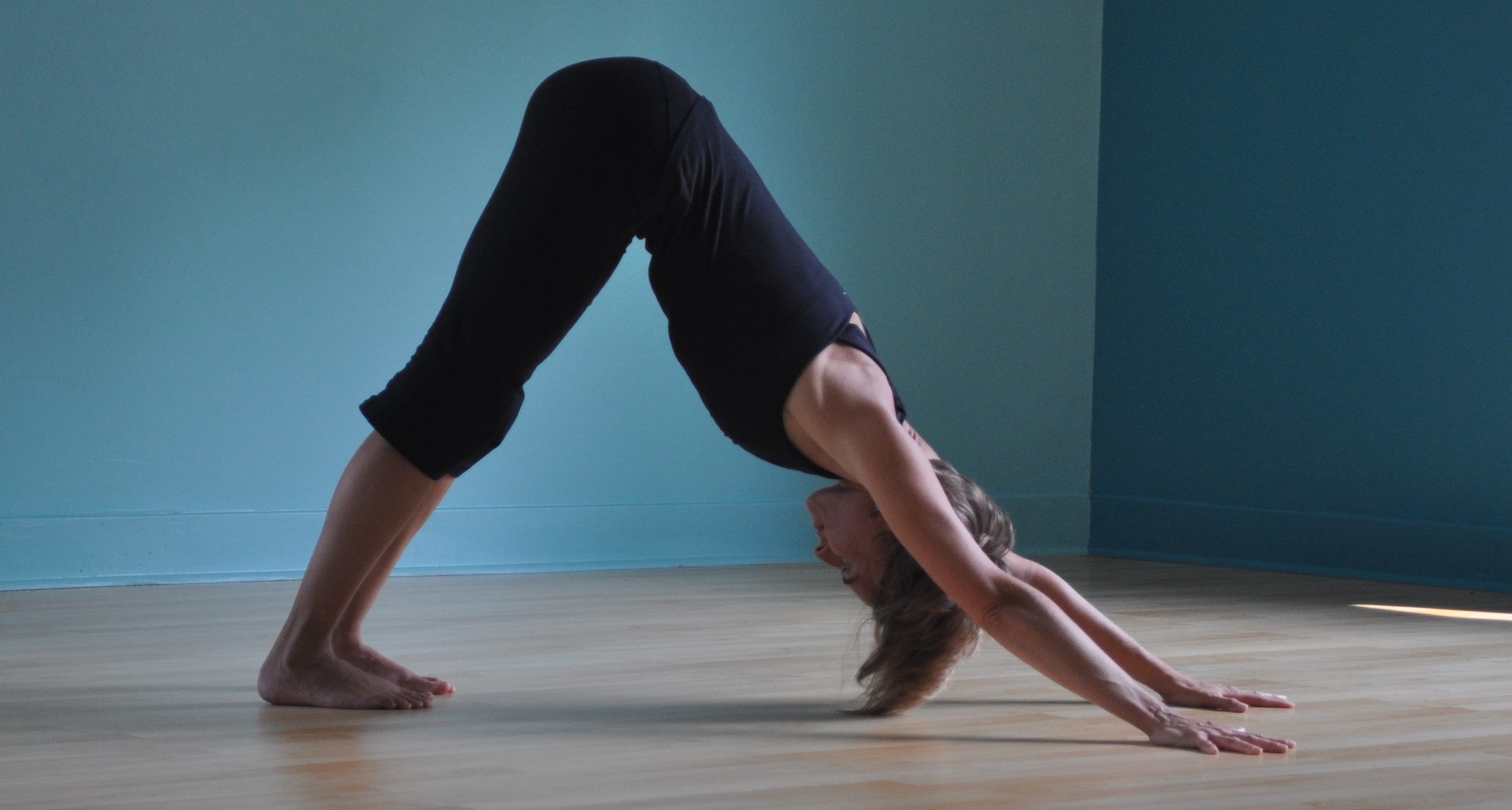
Start on hands and knees with your hands under your shoulders. Tuck your toes, press into your hands and lift your hips up and back so that your body forms an upside-down V. Keep your knees slightly bent if your hamstrings are tight, push the floor away and let your head hang between your arms. Hold for about five breaths, then lower your knees slowly. This stretches the backs of the legs and the shoulders. If you have wrist pain, high blood pressure or an eye condition such as glaucoma, ask your doctor first, because NCCIH lists severe high blood pressure and glaucoma among the conditions that may call for changes to poses.

How do you do a seated twist?

The traditional twist, Bharadvajasana, starts from a kneeling position. A simpler version works in a chair. Sit tall on the front half of the chair with your feet flat on the floor. Place your right hand on the outside of your left knee, hold the back of the chair with your left hand and turn gently to the left, looking over your left shoulder. Keep your hips facing forward and your spine long. Hold for three to five breaths and repeat on the other side. The old version of this article said to do the twist once an hour if you have lower back pain. I have removed that advice, because there is no basis for it. A better habit is to get up and move often, in line with the Physical Activity Guidelines for Americans, which tell adults to sit less.

Where can you learn more?

Our post on basic yoga postures explains more poses, and yoga postures and styles gives an overview of the main styles. For a standing stretch that suits a desk break, try the triangle pose, and read what yoga is if you are just starting out. The photo below shows the downward-facing dog.

Yoga pose for computer users stretching back and hamstrings.

Adho mukha svanasana Yoga for Computer Users

Book: Yoga for Computer Users by Sandy Blaine
View this book on Amazon (affiliate link: we may earn a commission at no cost to you)

Practice and Doctrine of Yoga

by on Sunday, March 13th, 2011

Yoga is often introduced as a sequence of stretches, yet its traditional literature extends into concentration, ethical practice, attention and questions about the mind. The Doctrine and Practice of Yoga, the book introduced in the original Veggie-Blog post, belongs to this broader tradition.

What subjects does the book introduce?

The available historical description is brief. It mentions exercises in concentration, objective and subjective attention, active and passive mental processes, Maya, guru worship and a concept called “Will-Force”. These are the terms used in the description; their interpretation depends on the text’s philosophical context. We cannot establish the book’s full contents or specific practical instructions from that description alone.

How is traditional yoga broader than postures?

The Sanskrit term yoga has been understood in different ways across Indian philosophical traditions. Modern studio classes often emphasise postures, breathing and relaxation. Older texts may instead focus on sustained attention, ethical conduct, meditation or the relationship between experience and perception. The National Center for Complementary and Integrative Health notes that yoga originated as a spiritual practice and that modern health-oriented yoga often combines postures, breathing and meditation.

What is Maya in yogic philosophy?

“Maya” is a philosophical term used differently across traditions, often in discussions of appearance, illusion or how we perceive reality. It should not be reduced to the claim that the physical world simply does not exist. Readers will benefit from noticing which tradition and author are using the word before drawing conclusions.

Do concentration exercises require a particular belief?

Not necessarily. A reader may explore basic attention practices, such as observing the breath or returning focus to one sound, without adopting every metaphysical claim in a text. Religious and philosophical concepts should nevertheless be represented respectfully rather than erased from their original context.

How can beginners approach older yoga writing?

Read slowly, identify unfamiliar terms and compare interpretations across reputable sources. If you choose to practise movement or breath exercises, avoid forcing flexibility or holding the breath aggressively. Experienced instructors can help with safe modifications, especially if you have an injury or medical condition.

Is yoga always safe?

Most gentle yoga is well tolerated by healthy adults, but sprains and strains can happen. NCCIH advises beginners to avoid extreme practices and recommends qualified instruction. Pregnancy, glaucoma, severe high blood pressure and some musculoskeletal conditions may require modified practices.

Further reading: NCCIH: Yoga—Effectiveness and Safety.

Related on Veggie-Blog: What Is Yoga?.

Explore the book on Amazon (affiliate link; we may earn a commission at no extra cost to you).

The featured image is an AI-generated illustration, not a photo or an official book cover.

How to Choose a Yoga Video for Beginners (and What a Good One Teaches)

by on Monday, February 28th, 2011

Finding a well-made yoga video that is truly suited to beginners can be a challenge. Most exercise videos are aimed at people who already know what they are doing. They may include a few easier moves, but the instruction assumes that you already know your way around. The few that are labeled “for beginners” can be repetitive and slow, and they sometimes give you no way to progress, as if beginners were going to stay beginners forever.

What should a good beginner video teach?

Clear instruction. A beginner needs more than a demonstration. A good teacher explains how to place your feet, where your weight should be and what the pose should feel like. When a teacher describes how the muscles of the feet should turn toward the big toe, you can feel it as well as see it. Calm, steady speech is a plus, since yoga depends on concentration.

A manageable number of poses. A class that introduces too many new poses at once is hard to follow. Look for one that repeats a small number of basic poses and builds up slowly.

Familiar basics. Many beginner classes include the cat pose on hands and knees, downward-facing dog, which looks like an upside-down V, and the corpse pose, which is lying on your back, completely relaxed. Our guide to basic yoga postures and their variations explains these and other essential poses.

Modifications and props. A beginner video should offer options for people who are stiff or new to yoga. For example, a folded blanket can go under the knees or the hips to make seated poses more comfortable, and a folded towel can help with some other poses. A teacher who tells you about these in advance is thinking about you.

A good ending. Most classes end with stretching and relaxation. Many use soft music, which may help you drift off. Choose a class with a final rest if you want to unwind.

Which video is an example?

One title that often comes up for beginners is Yoga Zone: Flexibility and Tone, taught by Alan Finger. It runs for about 50 minutes, and it is known for detailed instruction on alignment and for a relaxed teaching style. We cannot say that it is the right fit for everyone, and a DVD from some years ago may be hard to find, so treat it as an example of the style to look for, not a recommendation. Whatever you choose, preview a sample if you can, to hear the teacher’s voice and see how the class is paced.

Where can you try a class first?

Free classes are a low-risk way to find out what style you like. The video at the end of this post is a beginners’ class titled “Yoga for Beginners Part 1” from YogaEasy, which you can try before buying anything.

How can you stay safe?

Yoga is generally safe for healthy people when it is done properly, but sprains and strains can happen. The NCCIH advises learning with a qualified instructor if you can, and moving slowly and carefully. Never force a pose, and stop if you feel pain. If you are pregnant, are over 65 or have a health condition, check with your doctor first. A video is not a substitute for a live teacher, but it is a good starting point, and many people go on to take a class after a few weeks at home.

If you would like to learn what yoga is all about, read our posts on what yoga is and how to choose a yoga video, or try the 12-step sun salutation.

Yoga for Women: How to Gain a Shapely Waist Through Yoga

by on Saturday, January 22nd, 2011

Yoga for Women: How to Gain a Shapely Waist Through Yoga

Waist size is an indicator of overall fitness for many people. Most health experts agree that a smaller waist is healthier than a large one. The reason is that extra fat around the waist is linked to higher health risks such as type 2 diabetes, high cholesterol and high blood pressure.

In evolutionary and biological terms, a small waist signifies youth and vitality. But endless sets of crunches alone will not give you the waist of your dreams, because you cannot burn fat from just one spot of the body. You will need to combine specific waist-oriented exercises with ones from other disciplines, together with a healthy diet.

Specifically, you will need to work the inner girdle of muscles, commonly known as the core muscles, with slow, controlled abdominal exercises that reach deep into these muscle groups.

While yoga is usually associated with flexibility, some exercises from yoga-based workouts, like those in our Yoga for Women series, also work the deep core muscles around the waist.