Posts Tagged ‘Yoga’

The New Yoga for Healthy Aging by Suza Francina

by on Tuesday, July 26th, 2011

Suza Francina’s The New Yoga for Healthy Aging approaches yoga as something that can change alongside our bodies. Instead of expecting every reader to perform a standard pose, its description emphasizes props, gentle modifications and step-by-step photographs. That focus makes it relevant to older beginners and people looking for a less demanding practice.

What is the original book about?

Francina is associated with the Iyengar approach to yoga, in which the careful use of supports such as blocks, straps, chairs and blankets can help people adapt a posture. The book’s description presents accessible poses for readers concerned about ageing, stiffness and mobility. It is not a book that expects everyone to be athletic or exceptionally flexible.

What should readers understand about the health claims?

Some older promotional descriptions suggest that yoga can prevent serious problems such as osteoporosis-related fractures. That goes too far. Yoga may contribute to balance, strength and well-being, but it cannot be relied upon to prevent fractures or treat osteoporosis. In some circumstances, strong twisting or deep forward bending may require modification for someone with fragile bones.

The NCCIH guide to yoga and safety specifically notes the need for extra caution in older adults and recommends discussing relevant health conditions with both a healthcare professional and the instructor.

Is the book still available?

Francina still lists the title on her own website. It remains useful as a historical introduction to accessible yoga.

Related on Veggie-Blog: What Yoga Can and Cannot Do and Making Yoga a Lifetime Habit.

Book: The New Yoga for Healthy Aging by Suza Francina
View this book on Amazon (affiliate link: we may earn a commission at no extra cost to you)

The featured image is an AI-generated illustration, not a photo of real people or an official book cover.
The Complete Idiot’s Guide to Yoga by Joan Budilovsky

by on Sunday, July 24th, 2011

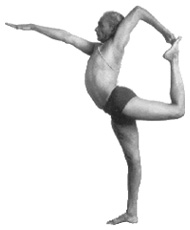
The Complete Idiot’s Guide to Yoga was written to make yoga feel less daunting. Its illustrated approach explains what a posture looks like and how a beginner can move into and out of it. If you have ever opened a yoga book and felt overwhelmed by unfamiliar names or complex positions, that accessible format is the central appeal here.

What will you find in this book?

The edition described in the original Veggie-Blog post emphasizes step-by-step, two-colour line illustrations rather than ordinary photographs. The drawings are intended to show both the shape of a pose and the movements involved in reaching it. The book sits within a series aimed at readers who want the basics without a lot of specialist terminology.

It is also worth checking the edition before you buy. The Complete Idiot’s Guide to Yoga has appeared in multiple editions, including later illustrated versions. Bibliographic records credit Joan Budilovsky and Eve Adamson as authors; the older page title mentions only Budilovsky.

Is a yoga book enough for a complete beginner?

A clearly illustrated book is useful for learning vocabulary, exploring simple postures and deciding which approach appeals to you. It cannot, however, tell you whether you are compensating for a stiff hip or putting too much pressure on a knee. The US National Center for Complementary and Integrative Health (NCCIH) advises practising with a qualified instructor, especially when learning unfamiliar movements.

Begin with comfortable standing and seated positions, keep breathing normally and do not force a shape simply because the illustration makes it look easy. Anyone with significant joint problems, a recent injury or another health concern may need specific modifications.

Can you still buy the book?

Used editions are still offered, although condition and stock vary.

Related on Veggie-Blog: What Is Yoga? and Before You Start Yoga: Warm-Up and Breathing.

Book: The Complete Idiot’s Guide to Yoga by Joan Budilovsky and Eve Adamson
View this book on Amazon (affiliate link: we may earn a commission at no extra cost to you)

Where Did Yoga Come From? Its Meaning, Early Texts and What Scholars Can Say

by on Friday, July 22nd, 2011

The old version of this post opened with a list of modern worries (stress, a sedentary lifestyle, toxins in food and air) and then said that yoga “was developed over 5,000 years ago in India,” that it “predates all other religions,” and that its “holistic benefits” suit everyone. The history is more interesting, and less certain, than that. This rewrite looks at what yoga means, where it first appears and what the evidence does not show.

What does the word “yoga” mean?

The old post is right that yoga is a Sanskrit word connected with the idea of union, and that it is often explained as “to join” or “to yoke.” The Bhagavad Gita, one of the best-known Indian texts, defines it in several ways, including equanimity and skill in action. In many traditions the aim is a union of the individual self with a universal self, which is how the old post described it. That is a spiritual goal, not something research can measure, and today many people practice yoga for exercise and relaxation instead.

How old is yoga?

The old claim of 5,000 years cannot be proven. In the introduction to their scholarly collection Roots of Yoga, the historians James Mallinson and Mark Singleton write that before about 500 BCE there is very little evidence in South Asian texts or archaeology for systematic, psychophysical techniques of the kind the word “yoga” later came to describe. The Rig Veda, the oldest Sanskrit text (dated to the fifteenth to twelfth centuries BCE), points to visionary meditation, and a hymn to a long-haired sage suggests an ascetic tradition like that of later yogis. But they call it “entirely speculative” to claim that the Vedic texts show evidence of systematic yoga practice.

Some older books also point to a carved seal from the Indus Valley civilization as showing a figure in a yoga pose. Scholars such as Geoffrey Samuel, Andrea Jain and Wendy Doniger now describe that reading as speculative, so it cannot be used to date yoga. A fair summary is that yoga-like practices go back well over two thousand years, and that the precise starting point is unknown.

Where is yoga first written about?

Ideas about yoga appear in the early Upanishads, philosophical texts from the first half of the first millennium BCE, and in the Bhagavad Gita, which the old post alludes to when it talks about yoga as a path. The Yoga Sutras attributed to Patanjali are the best-known classical text, and our guide to Patanjali’s Yoga Sutras explains why the date is debated. Much later, texts on hatha yoga describe the postures and breathing methods that most Americans now think of as yoga. According to Mallinson and Singleton, by the late eighteenth century hatha yoga techniques held a “virtual hegemony” across many yoga-practicing traditions in India.

Is yoga a religion?

The old post said that yoga is a spiritual path but that you do not have to make an ethical decision to practice, and that people of any background can take part. Britannica’s article on Hinduism is similar: yoga may be atheistic or theistic and may adopt various philosophical or religious principles. Practiced in a gym or studio, yoga is usually taught as exercise and relaxation, but you can ask a teacher how much spiritual material their classes include. See the Britannica entry on yoga in Hinduism for more background.

What did the old post get wrong?

The claim that yoga “predates all other religions” is not something history can support, and the line that yoga “purifies” the mind and body with “cleansing thoughts and food” should not be taken as a health claim. Yoga is not a cure or a detox; see how yoga became popular in America and what the numbers show and yoga explained: what it is and what the research supports for what studies do say. If you want to try it, start with a beginner class and a qualified teacher, as the NIH advises.

Origins of Yoga

Origins of Yoga

Yoga and Lower Back Pain for Computer Users: What the Research Says and How to Protect Your Back

by on Saturday, June 25th, 2011

Hours at a desk are hard on the back. If you work at a computer and often feel an ache in your lower back, you are in good company. The older version of this article made big promises about yoga postures and even told readers to practice “to the point where mild pain is felt.” That is not advice to follow. This updated guide explains what we know about yoga and back pain, how to look after your back at home, and when to see a doctor.

How common is low-back pain?

According to the National Center for Complementary and Integrative Health, about 80 percent of adults have low-back pain at some point in their lives. It is the most common cause of job-related disability and a leading reason for missed work. Most episodes last only a short time. Causes range from a strained muscle to problems with the discs and joints of the spine, and sometimes no specific cause is found.

Can yoga help?

It may help a little. NCCIH reports that a 2022 review of 21 studies, with 2,223 participants, found that yoga is slightly better than no exercise for low-back pain, although the small difference may not matter much to patients. An earlier 2017 review of 12 studies found small to moderate improvements in back-related function after three and six months compared with no exercise, and it was unclear whether yoga does better than other exercise. The American College of Physicians’ 2017 guideline recommends nondrug treatments first for chronic low-back pain, and yoga is one of several options it suggests. So yoga is a reasonable choice, but it does not cure back pain, and no posture “fixes” the spine.

What should you do when your back hurts?

MedlinePlus says a common myth is that you need to rest and avoid activity for a long time, and that health care providers do not recommend bed rest. If you have no warning signs, stay as active as you can. Stop normal activity for only the first few days, use ice for the first 48 to 72 hours and then heat, and avoid heavy lifting and twisting for the first six weeks. It also says not to exercise in the days right after the pain starts and to begin again slowly after two to three weeks, preferably with a physical therapist’s help. If you lie on your back, a pillow or rolled towel under your knees can ease pressure, and if you lie on your side, a pillow between your legs does the same. Read the full advice in MedlinePlus’s guide to taking care of your back at home.

How should you sit at the computer?

The same MedlinePlus guide gives practical rules. Use a chair with a straight back and an adjustable seat and back, armrests and a swivel seat. Put a stool under your feet so your knees are higher than your hips, and place a small pillow or rolled towel behind your lower back. Avoid high heels, and on long drives stop and walk around every hour. The same idea works at a desk: get up and move regularly. Our posts on the triangle pose for computer users and everyday activities that count as exercise show easy ways to break up the day.

When is back pain a warning sign?

The National Institute of Arthritis and Musculoskeletal and Skin Diseases says to see a doctor if your pain does not improve after a few weeks, or if it comes with numbness or tingling, severe pain that does not improve with medication, pain after a fall or injury, trouble urinating, weakness, pain or numbness in the legs, fever, or weight loss that you did not intend. Do not start any new exercise program, including yoga, until you know the cause.

What about the video below?

At the end of this post is a video titled “Sandy Blaine: Yoga for Computer Users.” I have not reviewed its movements, so follow it only if you feel comfortable, move slowly, and stop at any pain. NCCIH says people with lumbar spine disease and other conditions may need to change or avoid some poses, so ask your health care provider or a qualified instructor first. If you are new to the practice, start with what yoga is and the basic yoga postures.

The Seven Chakras: Names, Locations and Meanings

by on Sunday, May 29th, 2011

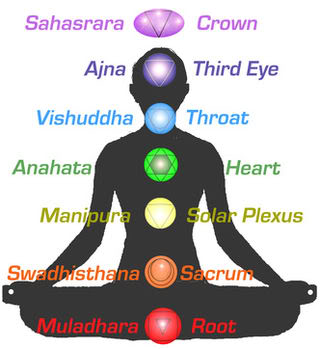
The seven chakras

What are chakras?

The word chakra is Sanskrit for “wheel” or “disc”. In yoga, Hinduism and Tantric Buddhism, chakras are described as energy centers in the body, lined up along the spine from its base to the crown of the head. Encyclopaedia Britannica describes them as focal points where psychic forces and bodily functions meet. They belong to a spiritual tradition and are not organs that you can see on a scan. Some texts speak of thousands of chakras, but seven main ones get most of the attention in modern yoga.

Each chakra is linked to an area of the body, a set of emotional and behavioral themes, a color and many other qualities, such as identity, goals and rights. Colors and meanings differ a little between traditions, and the rainbow scheme is the one most common today.

The lower chakras: root, sacral and solar plexus

Muladhara, the root chakra, is at the base of the spine. It is linked to stability, security and survival, and its color is usually red.

Svadhisthana, the sacral chakra, is in the lower abdomen, the pelvic area and the lower back and hips. It is linked to emotions, creativity and pleasure, and is usually shown in orange.

Manipura, the solar plexus chakra, is in the upper abdomen. It is linked to confidence, willpower and personal power, and is usually yellow.

The upper chakras: heart, throat, brow and crown

Anahata, the heart chakra, is at the center of the chest. It is linked to love, compassion and connection with others, and is usually green.

Vishuddha, the throat chakra, is in the throat. It is linked to communication and self-expression, and is usually blue.

Ajna, the brow chakra, sits between the eyebrows and is often called the third eye. It is linked to intuition and insight, and is usually indigo.

Sahasrara, the crown chakra, is at the top of the head. It is linked to spiritual awareness and a sense of connection with something larger than yourself, and is usually violet or white.

What is kundalini?

In the tradition, a spiritual energy called kundalini lies dormant at the base of the spine, in the root chakra. It is often pictured as a coiled snake. Yogic practices aim to raise it step by step through the chakras until it reaches the crown, which is the stage of self-illumination. The chakras are described as valves or pumps that regulate the flow of this energy through your system.

How does yoga come into it?

Teachers of this tradition say that the movements, postures and breathing of yoga, together with meditation, can help you focus on each center in turn and bring a sense of balance to your mind, body and spirit. These are traditional beliefs, and there is no scientific proof that chakras exist as physical structures. You can read more about how people work with them, and what research says, in our companion post on chakras and yoga. If you are new to yoga, start with our post on what yoga is and learn about the history in the origins of yoga.

The seven chakras

The seven chakras